A pre-Covid Trip of a Lifetime
The following article is made available to subscribers only – unless you happen to follow me on Linked In in 2020, where I originally posted this publicly. 🙂 Enjoy.
FYI – I am no longer affiliated with WPGL, and they most certainly don’t want to be associated with me and my crazy opinions, which are my own.
Panama
May 2020
It has to be said, I have a pretty cool job. After about 14 years of working in different parts of the maritime industry, about 2½ years ago I ended up as the Technical Advisor to Witherbys for all things Navigation. As part of my job, I have the privilege of travelling to some pretty unique places and learning from some exceptional seafarers.
I get to see some of the world’s best Marine Pilots at work in some of the busiest and most challenging navigational seaways. My task is to gather what I’ve learned or observed and bring it back to Witherbys for the benefit of our customers.
However, our latest Witherbys expedition has to be the absolute highlight of my career so far. Our CEO, our Commercial Director and I were invited to the Panama Canal, to shadow Panama Canal Pilots on Neopanamax ships that are now using the new and expanded Panama Canal locks. We spent almost 2 weeks with the Canal Authority, the ACP, learning as much as we could about the canal, the expansion, the latest procedures and the protocols for high-value Neopanamax ships, such as LNG carriers, that are now transiting the canal daily.
It is hard to explain to a non-seafarer the significance this trip has for a shipping geek like myself. To understand why Panama is special, you have to know a little bit about career development at sea and the level of skill required to be a Panama Canal Pilot.
If you’ve ever so much as attempted to steer a swan-shaped pedal boat across the local pond, or tried to bring a rowing boat alongside a jetty against even the slightest breeze, then you will understand that boaty-floaty things generally require some degree of skill.
When you become a professional seafarer, you quickly realise that there are also many other skills that you will need to learn. So many in fact, that whenever people ask what you do for a living, they will simply think that you are a compulsive liar.
“Ah, so you’re a nurse? I was the medic on my last ship. Oh, you’re a long-haul truck driver? That’s half my job in a nutshell. Aha, you operate radio and satellite equipment? I do that every day!”
As seafarers we are used to being met with a sceptical rolling of the eyes when we try to explain the job of a Merchant Navy Officer. When I lived in South Carolina, the responses varied from ‘alright buddy, whatever’, to a stiff salute and a ‘thank you for your service, sir’.
That’s why we don’t typically bother speaking to non-seafarers about this stuff. We speak to each other and maybe our nearest and dearest ashore.
One thing we all know from our first day on board ship is that there is a hierarchy. And in the Merchant Navy, Captains are called ‘Master Mariners’ indicating a level of skill that takes thousands
of hours of training, education and real-world experience of shiphandling. Something most aspire to, but few achieve.
Another thing we all know from our first year as cadets, is that the Master is always right – UNLESS, a Panama Canal Pilot is on board.
When you are so green that you barely know the pointy-end from the other one, but your confident Captain actually knows when you’re halfway across the Atlantic just because the vibration of the hull has changed slightly when you pass over the continental shelf, it comes as a bit of a shock that someone can come on board and tell the Captain, your hero and mentor, what to do.
Understanding this is key to understanding the almost mythical status that Panama Canal Pilots hold in our Industry. The Panama Canal is the only place on earth where the Marine Pilot takes full responsibility for the navigational conduct of the ship. Everywhere else, the Pilot is an advisor on local conditions. The fact that the Panama Canal Pilot takes command of the navigation is more than a little significant!
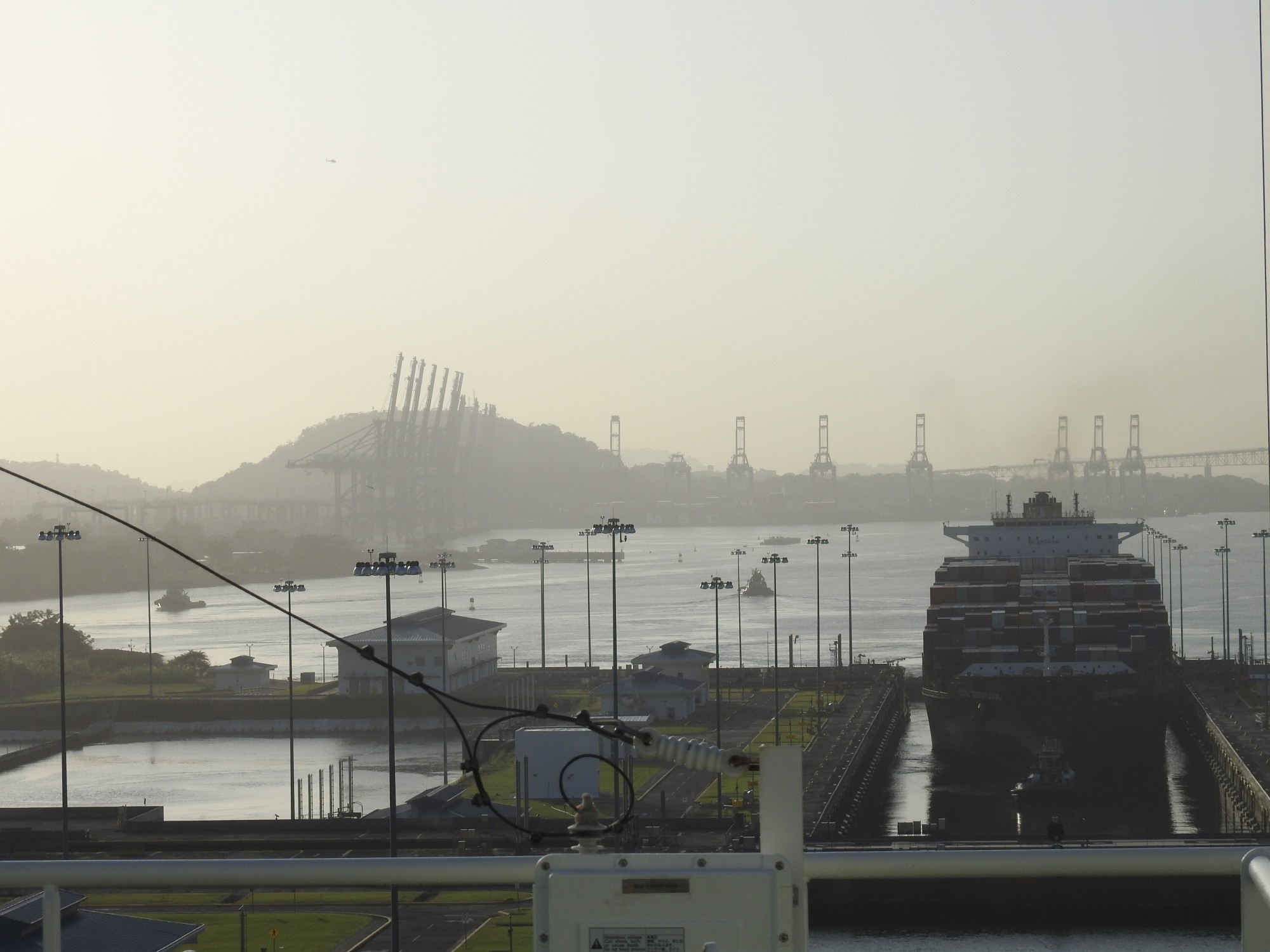
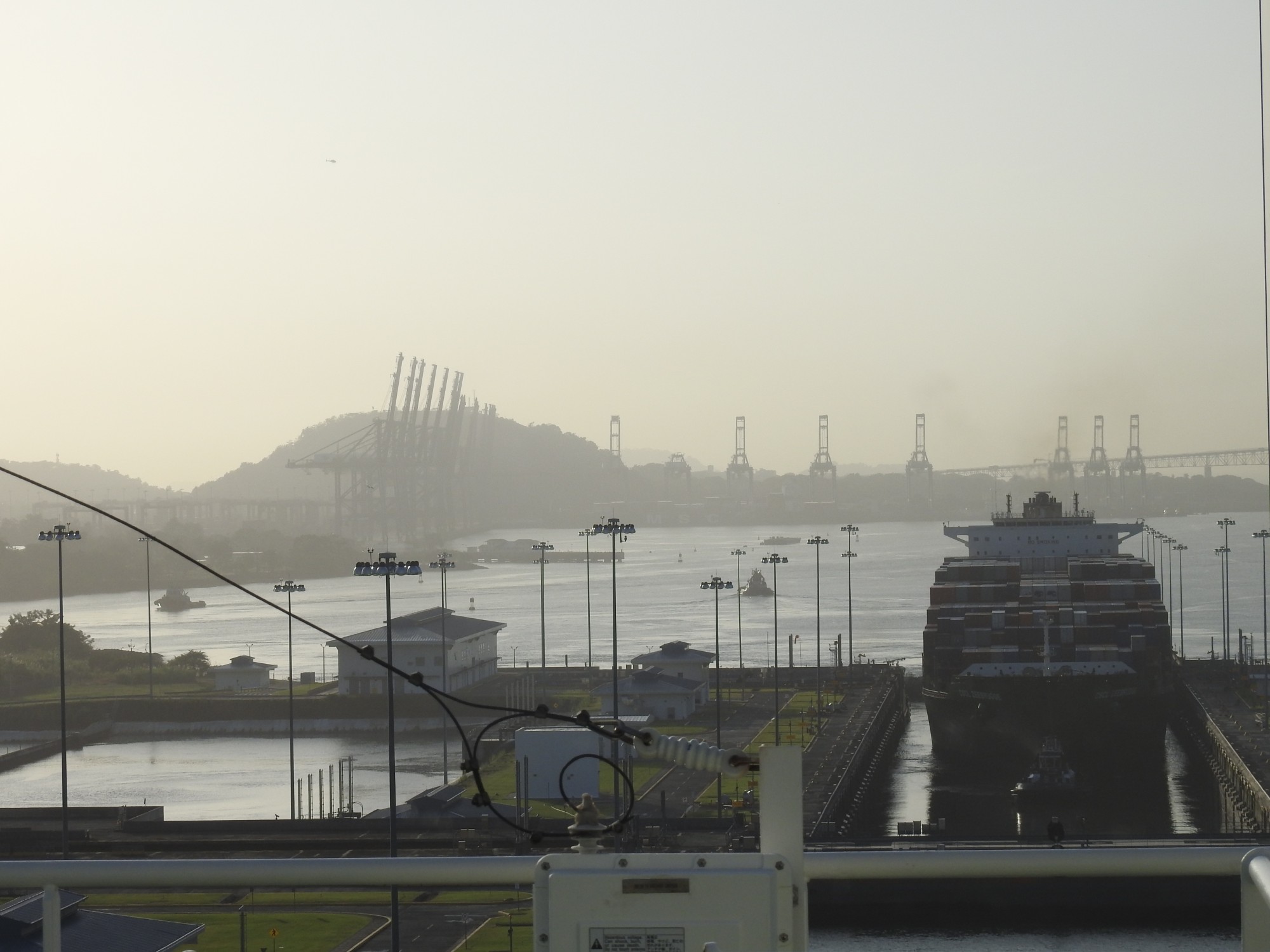
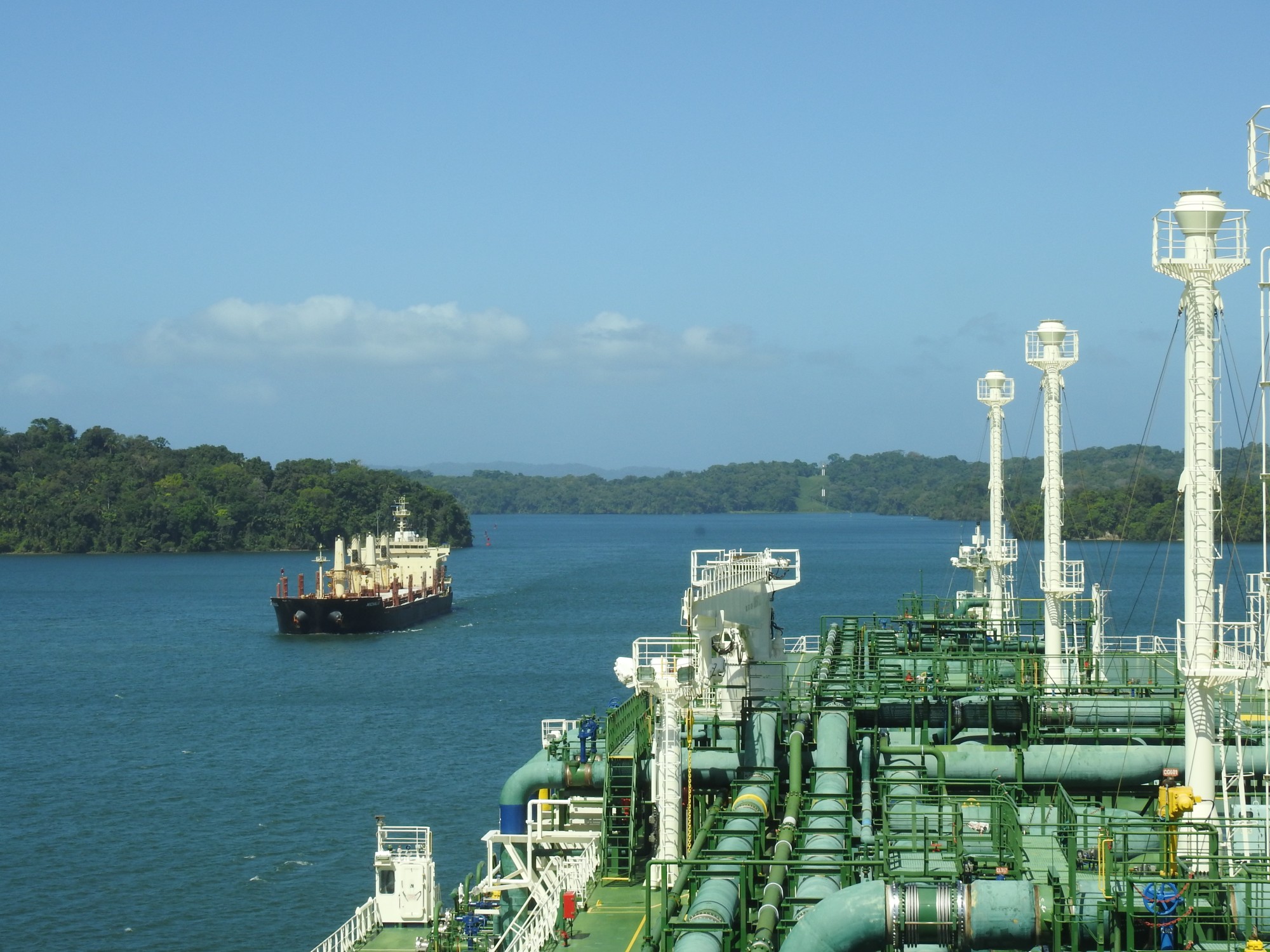
It is an awe-inspiring level of responsibility, and one that is not taken lightly by ACP Pilots like our first host, Fernando Jaén. Fernando met us at Diablo Pilot station, about a 30 minute drive from our hotel in Panama City. We then drove in ACP owned SUVs from Panama City on the Pacific Coast, halfway along the canal to the Pilot station at Gamboa, passing through the scattered rural communities that protrude from the jungle along the highway. We would be joining a Neopanamax LNG Carrier at Gamboa Crossing, where the Cut meets Gatún Lake, and taking her out to the Atlantic via the newly expanded locks at Agua Clara.
Fernando is calm, inquisitive and polite. He carries himself with the understated confidence that only comes from decades of professional experience. After boarding by the combination ladder and performing the handover, we round the turn into the main body of Gatún Lake and Fernando takes the con from the previous Pilot, to ‘get a feel for the ship before the locks.’
We are the first Northbound ship of the day to approach Agua Clara locks, so we have to wait a little as the final Southbound ship exits the locks. “There is no landing wall here, due to the extreme water depth”, Fernando informs me. “We have to stay here for a moment”.
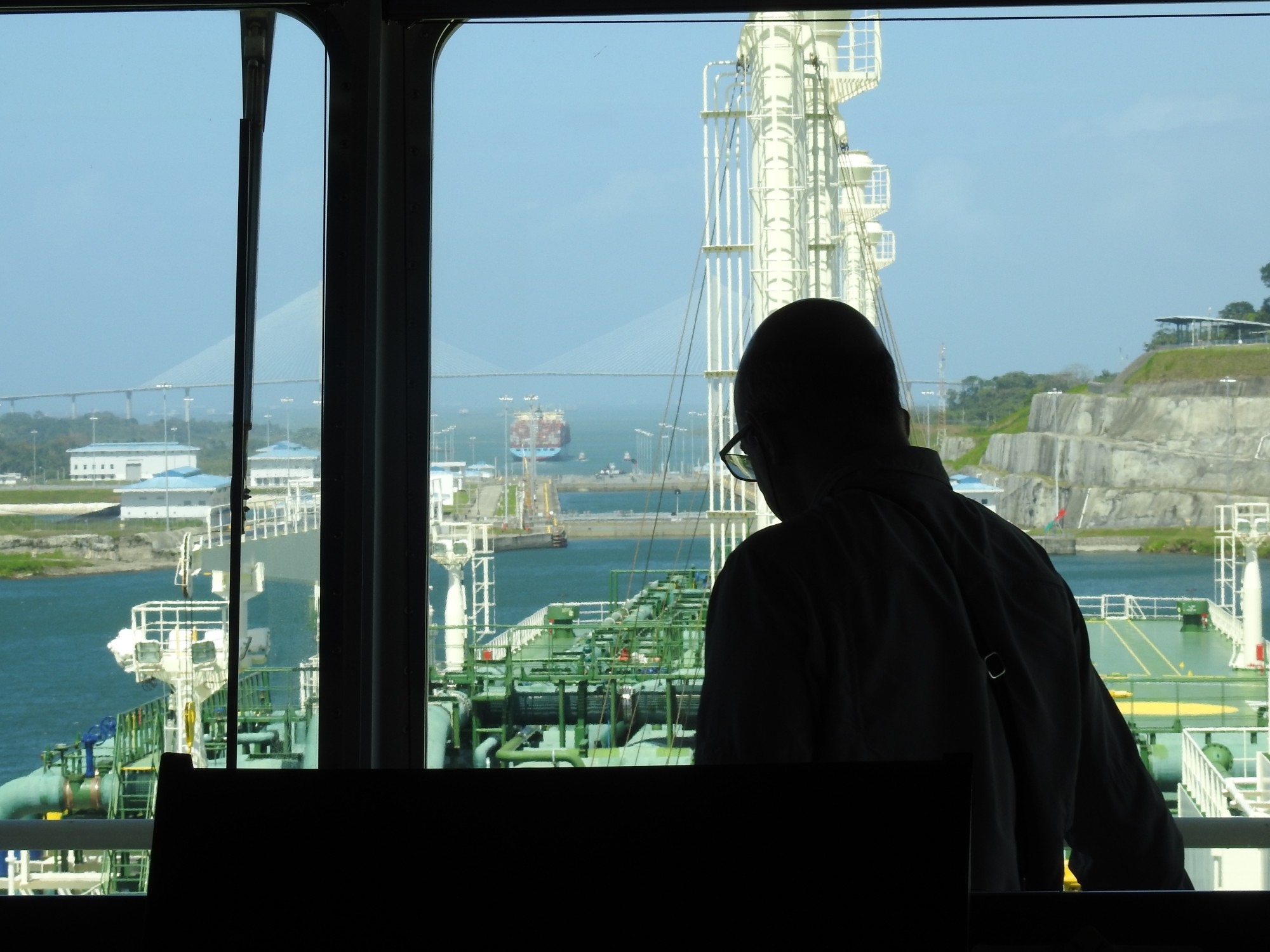
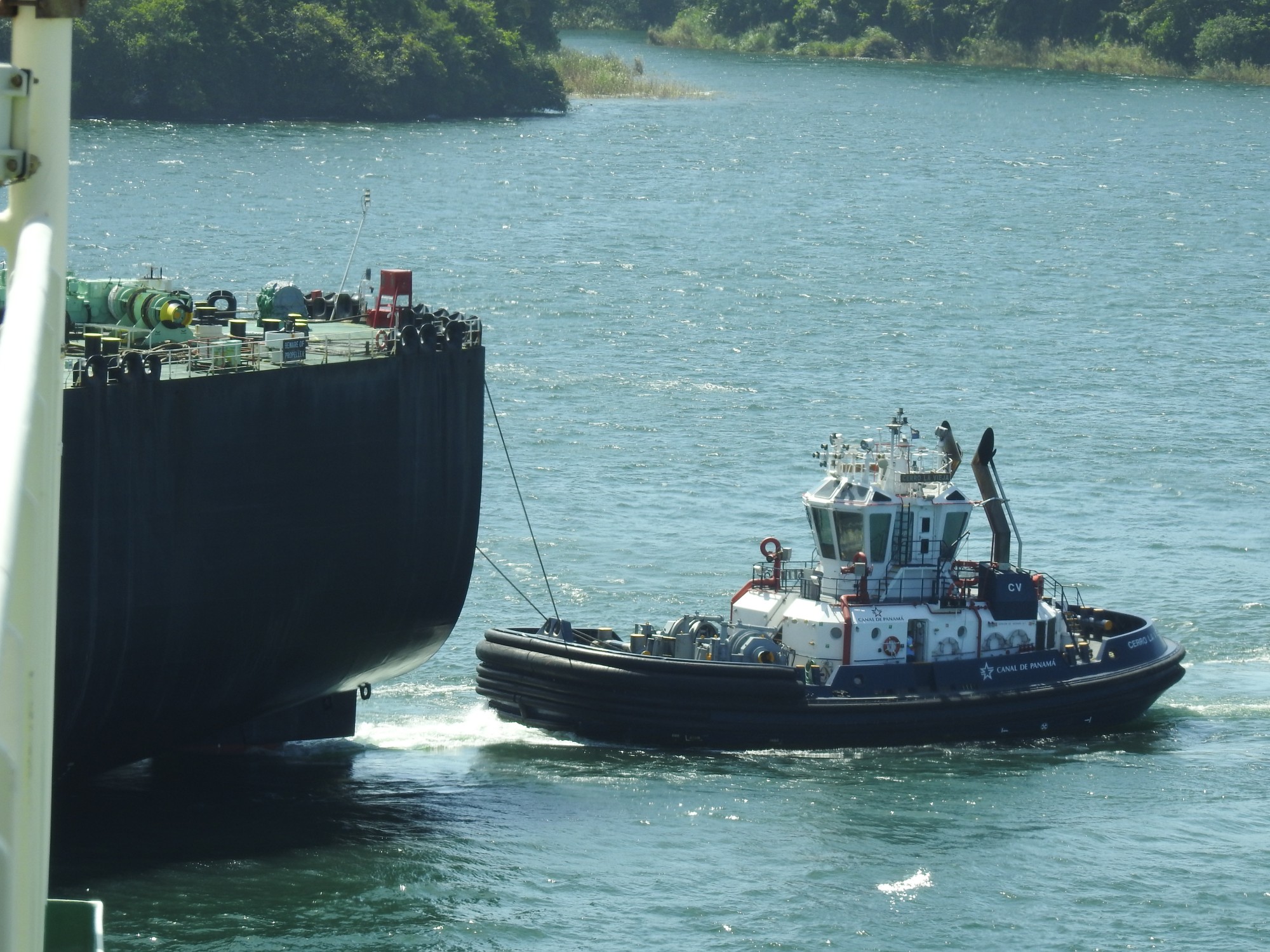
With a 92,000-deadweight ton LNG Carrier, 290 m (951 ft) long, 46 m (151 ft) wide and a draught of over 13 m (43 ft), ‘staying here’ is no simple matter. The dry season had started the week prior to our visit and at this time of day we are facing into a 28 knot Northerly wind pushing us away from the lock chamber entrance. We have 5 tugs in attendance, a single fixed pitch propeller. The concrete and steel construction of the lock chamber looks formidable and unforgiving from a distance, despite the substantial fenders. Even with a little bow thruster, most people would think twice before taking responsibility for a ship they’d never set foot on before, at this critical moment.
If Fernando harboured any self-doubt in his ability to handle this behemoth and her 170,000 m³ of cryogenic cargo, he wasn’t showing it. With only 2.5 m clearance on either side of the ship, and a strong wind gusting to a near gale force pushing us off, many a Master Mariner would be feeling the pressure.
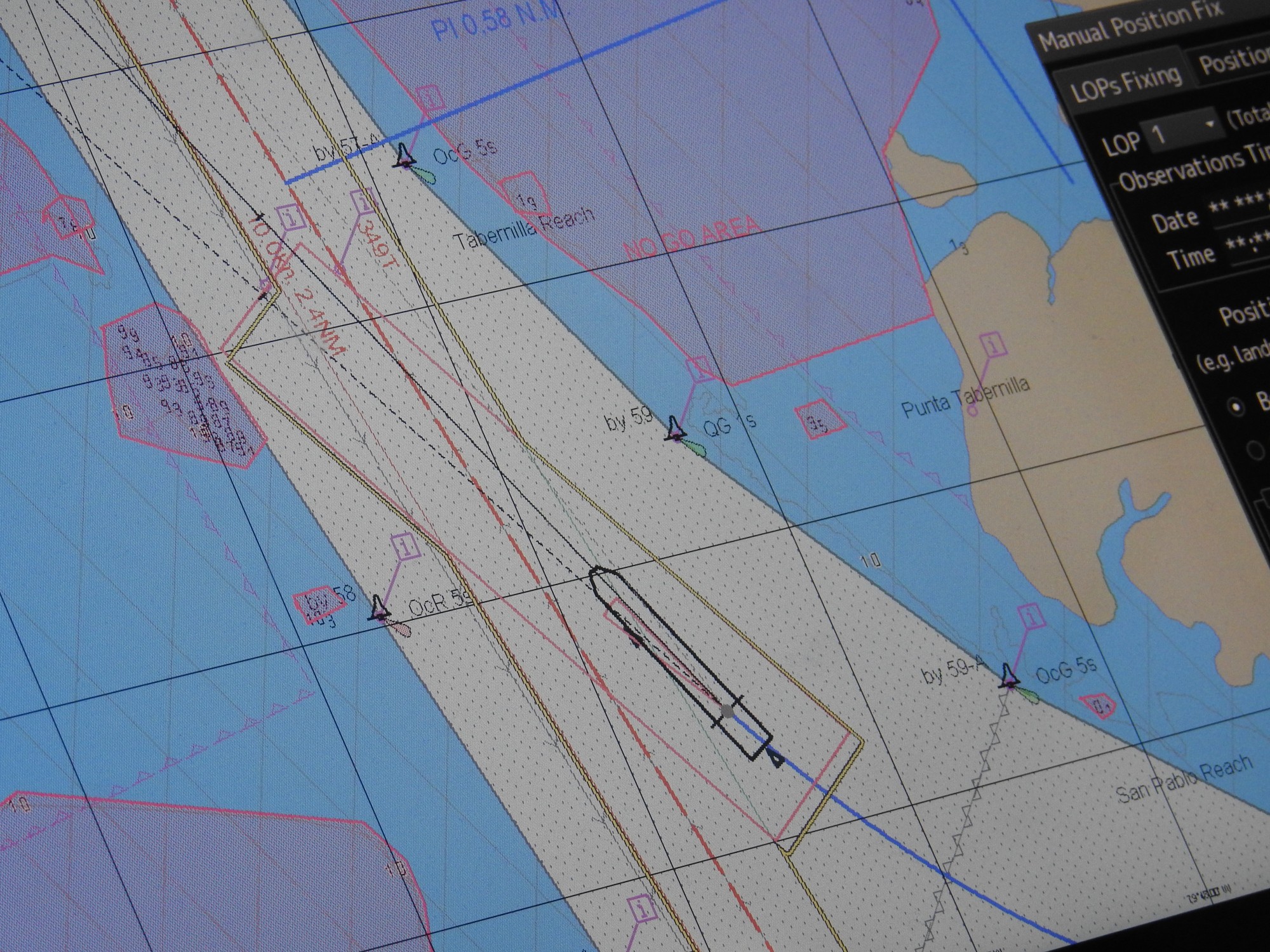
He moved to the Starboard Bridge Wing and assumed his commanding viewpoint. The sophisticated PPU computer is tied to a post for easy visual reference, although he is clearly doing this manoeuvre by the traditional Mark-I eyeball technique.
Commands are issued successively to the bridge team and helmsman. Engine movements and steering orders are given precisely, and any miscommunication is quickly rectified by the Pilot. Communication is not easy in this wind, across a 46 m wide navigation bridge.
The movements of the 5 tugs and the mooring gang, some 21 ACP personnel on board, the lock Master and line handlers ashore are all coordinated with seemingly effortless precision. We are lined up. The new gates slide open into cavernous cuttings in the lock chamber. The ship is manoeuvred into position and made fast to the shore in a matter of minutes.
Slick. No drama. Impressive.
With 3 chambers, this act of Pilotage is repeated in a lockage procedure lasting 2½ hrs on a typical ship. With a shorter overall distance to run for the New ‘3rd-lane’, the Neopanamax ships typically transit the canal in 11 hours, up to 3 hours longer than the smaller ‘Panamax’ ships. The main reason for this additional time is the lockage procedure. Handling some of the largest ships on the ocean takes a little while.
Afterward, we departed the locks and disembarked by Pilot launch into a harbour that was experiencing slightly choppy waves by this point. In the 1-hour long car ride back to Panama City I had the chance to ask Fernando about the thought process of a Panama Canal Pilot and the kind of things that concerned him during manoeuvres. I complimented him on what I had seen today. I was then quite astonished to find out that this was not even his day job. This was his first Pilotage duty in several months!
Fernando, and each of the Pilots we sailed with, were known as ‘Administrative Pilots’. That means they work for the Transit Operations Division of the Canal as Port Captains, or similar roles. Fernando happened to be responsible for training other Pilots. In other words, he works 9-5 in an office for most of the year!
I was seriously impressed by this. Having left the sea 3 years ago as a Dynamic Positioning Chief Mate, I too have spent a lot of time in the office. I think I’d require a bit more of a refresher before driving something that size into a slot with just enough room to park a small Italian car on either side.
“That was amazing”, says I. “No, no, no, I’m a little disappointed today. I was a few inches off my position and that wasn’t very graceful. I wish I could have shown you a better approach, but this wind was very strong. I’m sorry for this”, says Fernando.
I couldn’t help but laugh, as his very high standards were revealed to me in this one simple comment. A few inches are nothing to you or me, especially on a ship up to 1200 feet long. However, precision clearly matters to these guys. I start to realise they have to think this way to remain uncommonly competent.
His humility becomes less surprising as he continues to speak. The point I made earlier about responsibility became relevant to me during this conversation. It is not just that Panama Canal Pilots simply take charge out of administrative authority. What gives them their status at the top of the Marine hierarchy? It is that they personally take responsibility.
As the crossroads of the Americas, and the link between the Atlantic and the Pacific, the Panama Canal has been a centre of world trade since opening in 1914. In the 106 years since the first ship, S.S. Ancon, transited the canal, literally every type of ship ever conceived by man has passed through these waters.
Sailing yachts, steam ships, oil tankers, passenger ships, container ships, single-screw, twin screws inward, twin screws outward, standard rudders, Becker rudders, Azi-push drives, Azi-pull drives, Voith Schneider propulsion, Steam Turbine and Gas Engine combinations, Bow Thrusters that don’t work if you’re going astern, old school engines, computer controlled engines. If you can name it, these guys can drive it. Often at a moment’s notice.
Most ports and Pilots only specialise in one or two types of ship because that’s all the port caters to. The Panama Canal is one of the only places on earth where every type of vessel converges on one location.
It becomes clear why the Panama Canal Pilots lead the world in standards of safety on canals and Pilotage. Their safety record is second to none. Fernando explains why.
“It has to be perfect every time. It’s not just the ship. I have 2 tug boats in the lock chamber with me. All the mooring gang and line handlers face risk of injury or death, if I make one wrong movement. It’s not just giving orders. I check every instruction is carried out in the right way, at exactly the right time. That’s why we must take control of the ship. There isn’t time for disagreement, or to convince people what they should be doing”.
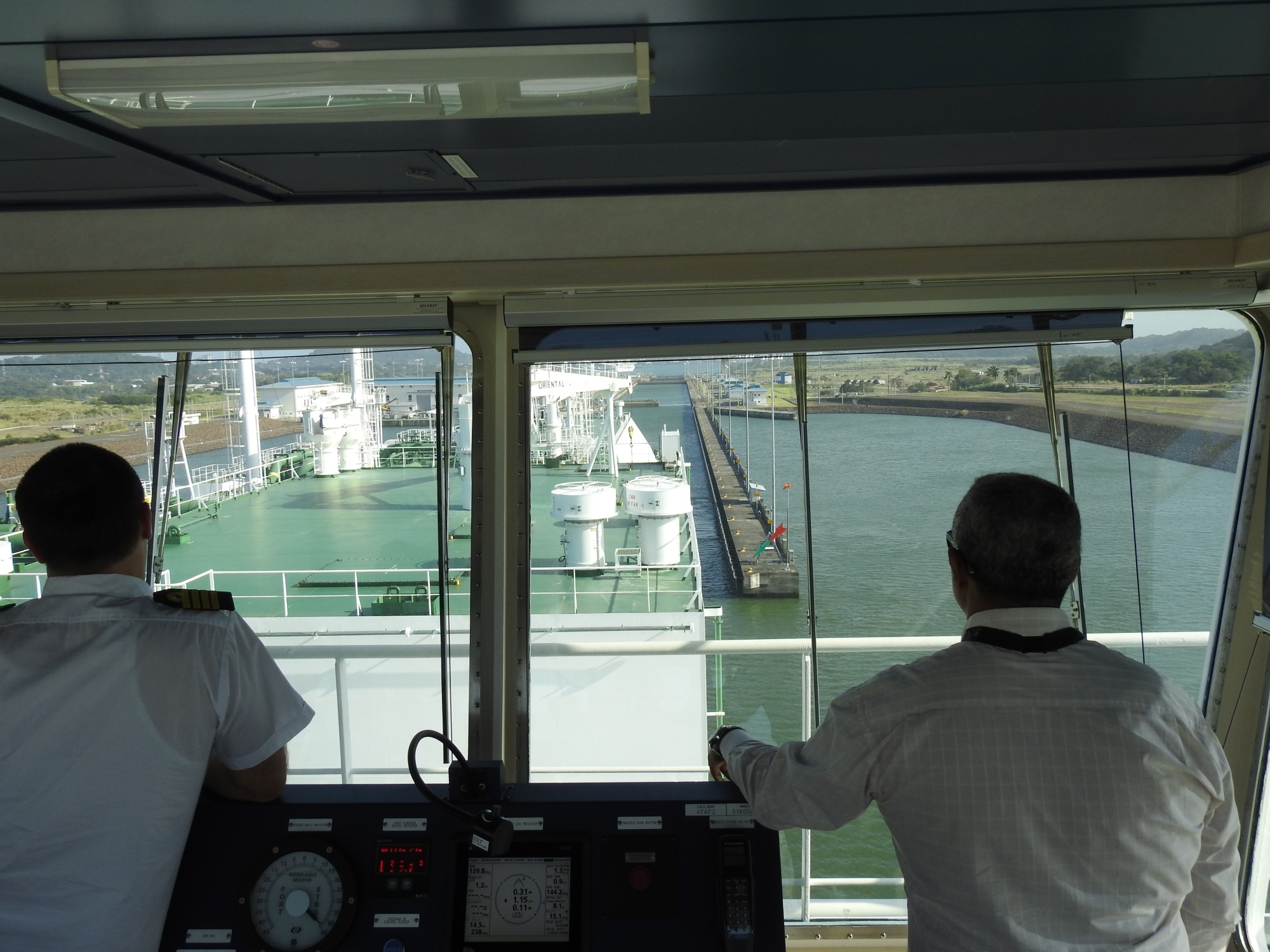
Fernando understands his duties as clearly as any Pilot. Although these administrative Pilots are limited to 20 Pilotages per year, he spends most of his days in the training centre.
“I train the Pilots and the PUPs at the manned model course”. “PUPs?”, I replied.
“The Pilot Understudy Program”.
It takes at least 2 years at sea to be considered qualified enough to even begin training as a Pilot on the Pilot Understudy Program. It then takes about 4 years working under the supervision of senior Pilots to be considered a full Pilot, capable of working independently. There are many more grades to achieve as there are 11 grades of Pilot, and it takes about 12 more years to reach grade 11. Each time a Pilot levels up, he must prove he is capable of handling larger ships, getting closer to ships of the maximum beam permitted in the Neo locks. Even the top ‘Grade 11 Pilots’ can attain additional specialisms adding to their rank, including LNG carriers and Nuclear Submarines.
Prior to the opening of the Neopanamax locks, ACP chartered a bulk cargo ship for 3 months, so that all Neopanamax Pilots could practice going through the new locks for real. Day after day they repeated the process until they were confident that the Canal was open for business. As experience was gained and confidence built, the beam restrictions on the Neopanamax locks were expanded to their current limits.
Many of the Pilots proudly recall that their heritage has been hard earned, and that working on the canal is a matter of honour. The economy of their country is very dependent on the canal. The world depends on the canal. And that is why they take every action seriously.
Our second host, Peter, drove us between the simulator training centre and the manned model course. After spending some (nauseating) time in the simulator and viewing some of the Canal infrastructure, it was clear why it has an untouchable safety record.
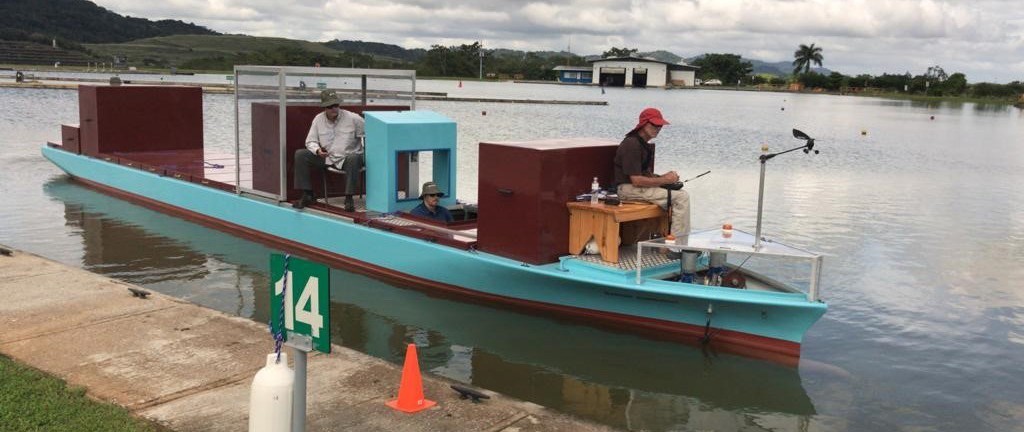
Another highlight, and a testament to the thoroughness of ACP professionalism was seeing the manned model course that was constructed in 2016. Costing many millions of dollars, this investment in training consists of a 1:25 scale model of the entire canal, and the Pilots are put through their paces on working 1:25 models of the largest ships that can transit the canal. Tug Masters are even part of the exercises here, as they operate remote controlled model tugs, with working winches. The only thing that cannot be controlled on the course is the wind, so the course has been built on the same heading alignments as the canal and is situated close to the canal so that the wind experienced is the same as the canal. To make the wind as realistic as possible, exercises are planned for the time of day when the wind is close to the 1:25 ratio. Even real canal water is used, to ensure the salinity is the same.
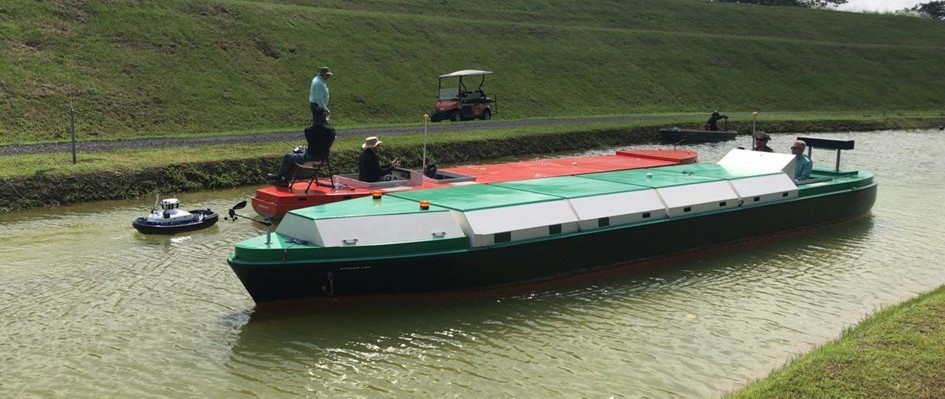
Sometimes we even get the same alligators’, Peter quipped, with only a slightly sinister smile.
Fernando was back at his day job, training the PUPs. They were practising emergency anchorages at the final approach to the locks. “Yes, the models have working anchors.”
The entire operation of the canal, from training of Pilots, to driving people to the job site, to dredging, surveys, operating the locks, managing the salinity of the water and maintenance of the boats is completely owned and operated by the ACP. Nothing is left to chance.
We conducted 3 more Pilotages on Neopanamax ships. 2 more LNGCs and one very large container ship. Each experience was an amazing example of organisational, technical and logistical excellence. And each one a testimony to the professionalism of ACP and the Panama Canal Pilots.