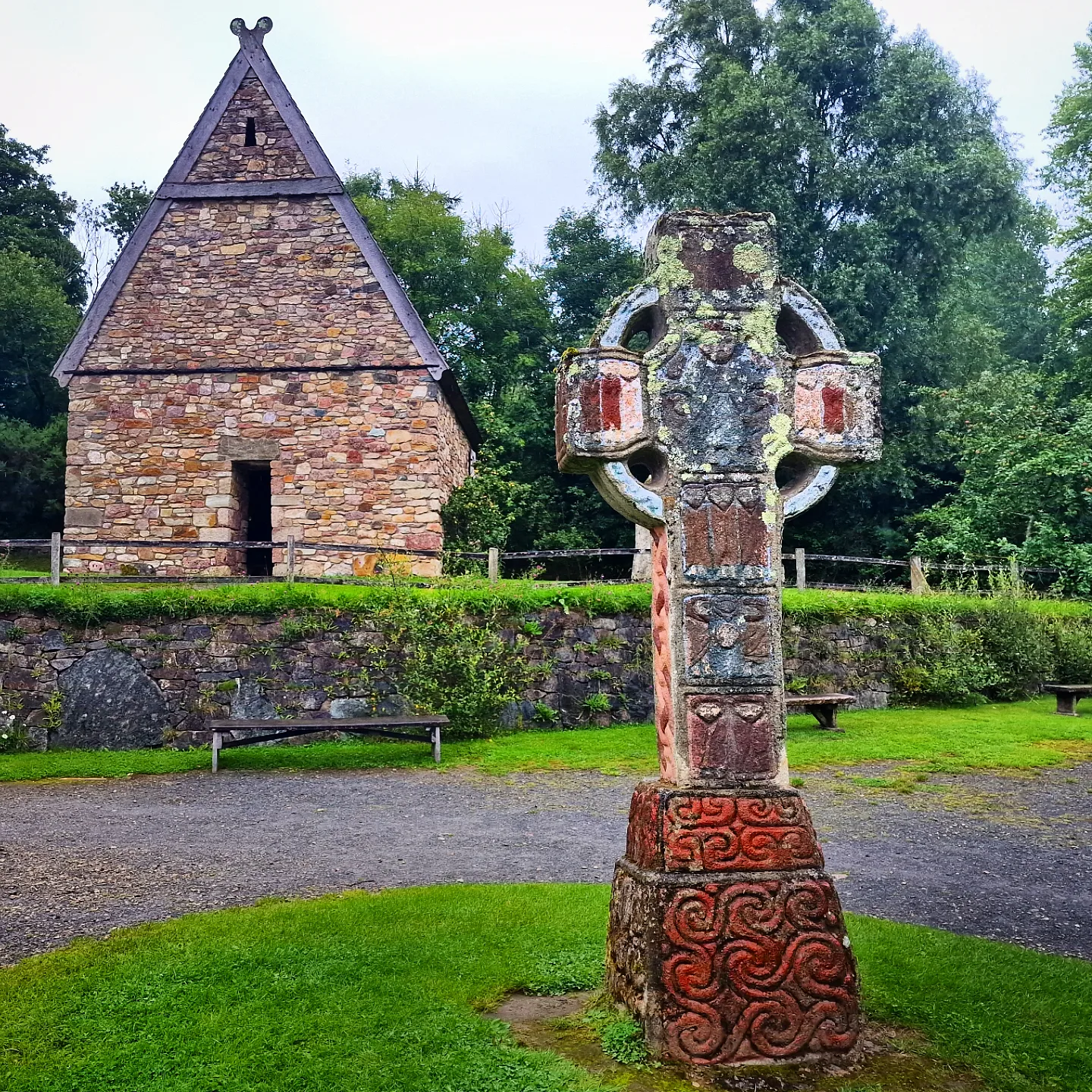
I’ve returned home. After one month at sea, we proceeded directly to Ireland for a little road trip vacation. We had planned to stay with a friend, who sadly had to cancel at the last minute. We decided to go anyway, as the kids had been looking forward to it. Also, we badly needed to get away from it all, and with the precious time fenced off, it was important to use it.
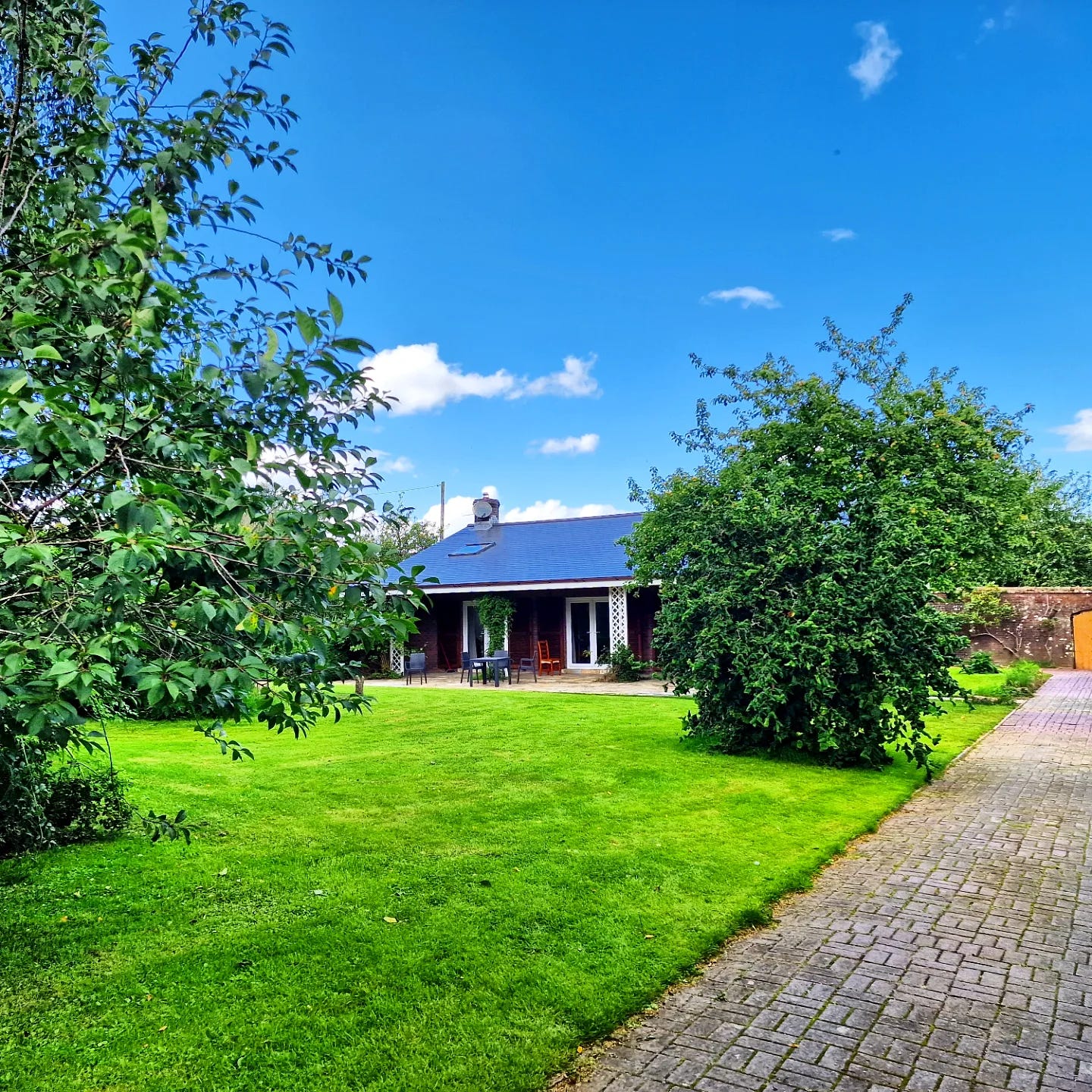
The last-minute Air B and B I booked was an absolute diamond. For less than the price of a cramped Premier Inn, we stayed at the wonderfully spacious and secluded gardener’s cottage at Wells House and Gardens in County Wexford. Nestled within a walled orchard garden, you access it through a beautiful semi-formal garden that lies adjacent to the Victorian country house attraction. The 1830s house replaced the original dwelling built for John Warren, an officer in Cromwell’s army who landed here in the late 1600s. Warren died childless and was betrayed by a relative, Hugh, who contrived to steal and fritter away his inheritance immediately upon his death of John, so the house did not remain with that family for long. The house is now a great attraction for tourists. It sits in beautiful grounds full of wooden sculptures that portray characters from ancient Celtic folklore, with a few modern children’s favourites thrown in. And when you stay there, you have access to the grounds, woodlands, gardens and farm animals all evening, after they close to the public.

It had been many years since I’d been to Ireland or Northern Ireland, and even on those few occasions, I think I came by sea to the ports of Belfast, Dublin and Cobh. This fact made our drive to county Wexford from Scotland, via the Stranraer ferry, all the more fun, as an exploratory first for all of us. Crossing the border from Northern Ireland into the Republic is marked not by the hard physical borders imposed by nation-states, but by some more subtle cultural cues. You cease driving over miles and begin measuring speed and distance by the kilometre. A & B roads turn into R roads. Union Jacks and Red Hand of Ulster banners hung low on lamp posts give way to the Green, White and Gold, tricolour. Service stations are the Amrican ‘circle K’ of Bill & Ted fame. McCoy’s and Walker’s crisps give way to Tayto’s and Hunky Dory’s.
The little village of Kilmuckridge, near Wells House still feels like you think real Ireland should. Although it is replete with the comforts of modern consumer capitalism, pubs, supermarket, a few restaurants, kerbside parking like an American strip mall, an ice cream parlour, and so on, the scale of it all is restrained and human. The supermarket stocks food from local farms and sells hurlings sticks behind the counter, for the men in the pub to whack each other with after closing.
You still hear people calling across the parking lot, things like: ‘Ma’! What toime are ye goin’ to maaass t’noight? Where would ye loike t’ sit?’, and so on, with a deep and genuine timelessness.
As a Scot, and a Campbell, our ties to Ireland are deep and strong. Campbells are not Anglo-Saxons but are Gael, Celt and Scot, with reports that our founding chieftain came from Ireland in the 1100s. They say the Scots themselves were named as such by Julius Ceasar, who was somehow aware of their affiliation with the daughter of an Egyptian Pharoah who died here in Ireland. Her name was Scotia, and her tomb can still be visited to this day, at the western edge of the old world near Tralee in County Kerry.
Scotia was said to have died fighting in battle, while pregnant on horseback, avenging the death of her husband. Kind of puts today’s ‘I don’t need no man, or country, or culture, or gender, or children – only a mediocre job, vibrators, cats and wine’ brand of feminism into perspective, doesn’t it?
The drive to Tralee or the west coast would have been too much on this occasion. A family holiday with a two-year-old, a four-year-old and an eight-year-old is logistically akin to a minor military expedition. A seven-seater family car with a roof box fills up quicker than you might imagine if you’ve never travelled with kids. Although, these are still by far my favourite kinds of holiday, given the unbelievable hassle and pointlessness still experienced in post 9-11 airports.
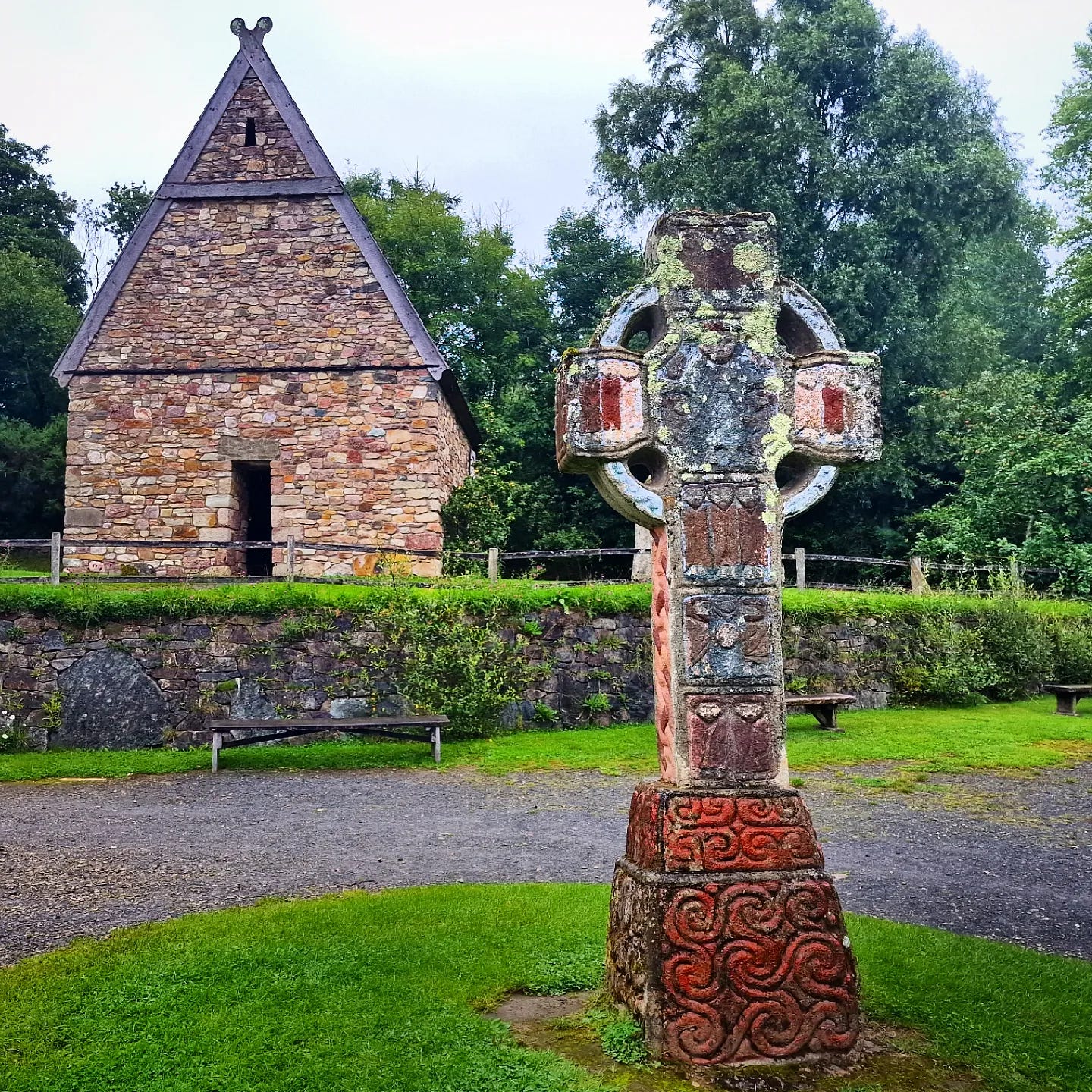
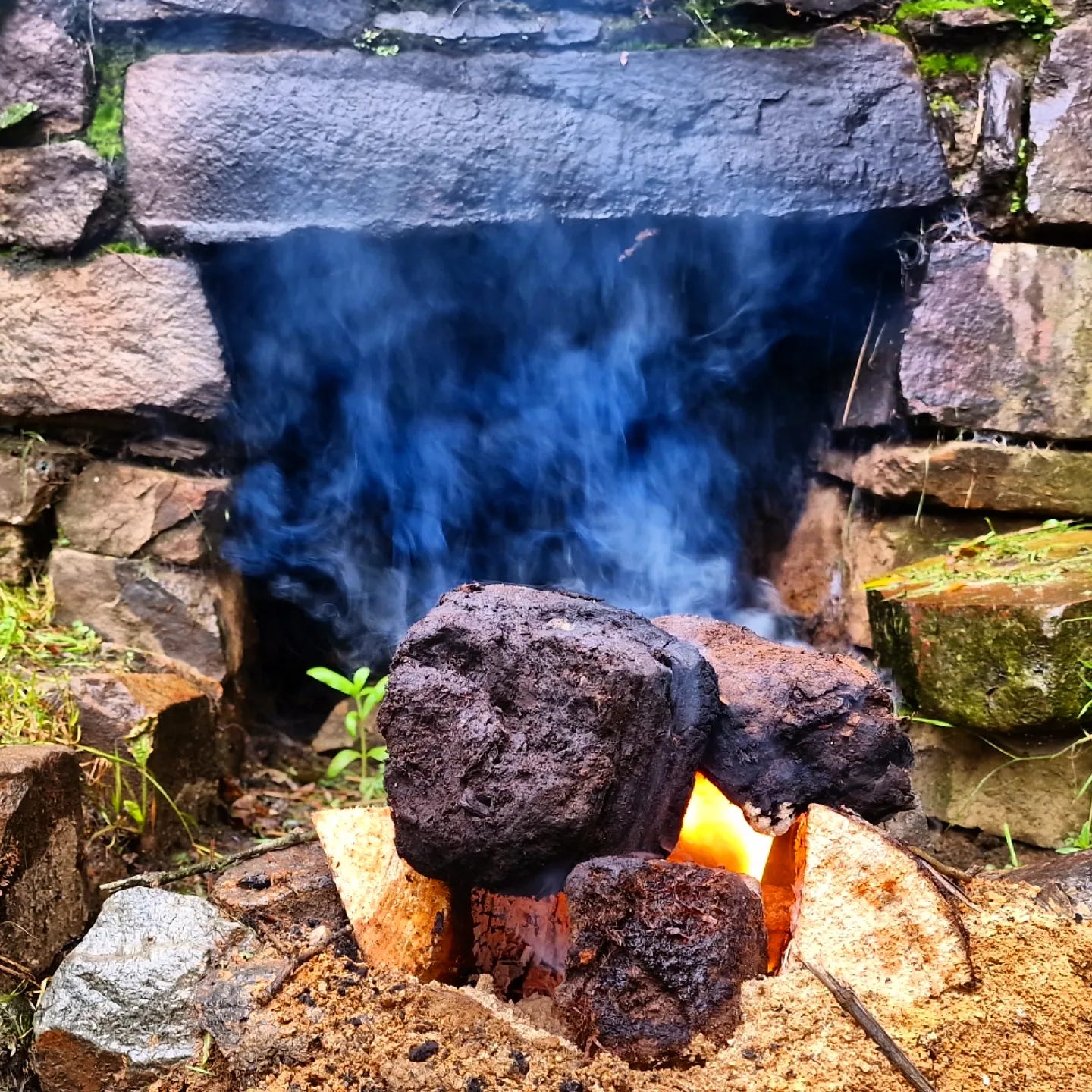
Aside from the ties of our universal history and ancestry, there are other things that allow me to feel right at home in Ireland. The ancestral atoms of Gael, Scot and Celt have merged into a fairly robust molecule of identity. The philosophical questions of the past 1000 years of modernity are still fresh in people’s minds and attitudes here. The Anglican and Catholic churches occupy respectfully exclusive and adjacent real estate in the village, and also in people’s civil life. The smell of peat fires burning always takes me back to childhood memories of life on Lewis, and the joys of digging your own winter fuel from the ground. The quality of food is exceptional, in a way that can only be achieved through simplicity and proximity to the source of production. The authenticity of life here remains intact.
Some of the many subtle differences were lost on my American wife and needed to be pointed out. The rainfall may be similar to Scotland, but feels slightly warmer, and marginally less horizontal due to our east Coast position. Lower latitudes have developed over centuries to produce slightly greater gains in agriculture. The ability to rear pigs with less climatic difficulty was an advantage. Good natural harbours and proximity to the continent have brought a tangible Norman or German feel to the size, layout and distribution of farm boundaries and houses. The roads are not straight, or uniform, and property rights have been accumulated over centuries. High, defensive hedgerows and tortuous roads have a strategic feel to them. As the Germans say, Strong fences make Good Neighbours. The Irish clearly agree. The stout walls that mark the boundaries between city terraces and grand farmhouses alike are much more robust and complete than in any part of Scotland. What would be exposed brick or blockwork in Scotland, is given a further boundary with a neat render.
These Irish farmers are clearly doing something right. I mean, their black pudding is rubbish, but their mastery of the pork banger and a good dram surprised me. I have avoided blended whisky like the plague for years, but no longer!
One thing I immediately felt and loved was that the clear presence of backbone and fortitude is felt in the architecture and the built landscape. The way their towns and villages have retained their central points of focus, and community. The way monuments are respected and the shared spaces are cared for. This must be part of the antidote to our revolutionary time.
One characteristic that the Scots and the Irish are both known for is their great sense of humour, and ability to enjoy the Craic. Craic means the noise and good humour associated with a communal good time. In American parlance, the racial epithet Cracker comes from Craic and meant specifically a loud and rambunctious Scots-Irish person. The subtle gradations of pale skin and ginger beards appeared indistinguishable to other residents of the new world, and so the volume of the way our colonial cousins spoke was their defining attribute to those who didn’t speak Gaelic.
Red necks were our invention too, as our skin, naturally attuned to maritime air masses and high-latitude sunlight, burned readily in the continental fields. Few people realise it, but New York is on the same latitude as the South of Italy and Central Spain. South Carolina shares its latitude with Morocco. And as you may have guessed, the hill farmers of Scotland and Ireland became the Hillbillys of the US, against whom Washington commanded his largest army, during the Whisky Rebellion.
The Irish however, are not the Scots. Despite our common bonds and similarities, the differences are what define us. As the nihilists point out all the time, we share 98% of our DNA with chimpanzees, after all. The tiny differences, therefore, are what matter the most.
During my lifetime I have observed that you can generally joke with Scotsmen about anything. Politics, religion, race, ethnicity, sexuality, rape, dead babies, etc. Irony is still a thing in Scottish jokes. Their skin has become impenetrably thick over centuries of winters spent huddled for warmth in tiny blackhouse barns or clinging to the boards below deck on fishing vessels being tossed around like Neptune’s bath toys during a tantrum.
The sensitive types didn’t last long in our history. Although now, sadly, I see that endurance turn to apathy. We do not have a meaning crisis. The world is full of meaning, and with our heritage in Scotland, even more so here. What we have is a nihilism crisis.
While I’m sure the ‘meaning crisis’ has extended its slimy tentacles into Ireland’s formal institutions, such as propaganda [state media and education], church, the civil service, and so on, the ‘locals’ are clearly having none of it.
Irish people have a limit.
I have long been aware of this limit. When you joke with the Irish in the same way you might with a Scottish friend (at least in my circles and experience), they will take the jokes and/or abuse up to a point. And then they don’t. And then, they really, really don’t.
While I fear the Dutch have lost the battle with the farmer’s protests and have become mired in the political distraction that comes with the musical chairs of reshuffling of coalition governments, the Irish are a lot more used to conflict. Drive around any corner of rural Ireland and you will see some seriously masculine men.
These people are not scared to pray. And they’re not scared to fight.
I really feel sorry for the man they send from the government to cull the Irish cow herds, in order to meet bureaucratic ‘Net Zero’ carbon targets. Those poor chaps, I believe, will meet the same fate as late Roman tax collectors and military conscriptors.
From the coastal village of Kilmuckridge to the modern dockside developments of Dublin, the influence of the now affluent American Irish who are physically re-membering their diasporic roots is palpable. The memories of famine, of government betrayal, and total indifference to poverty and starvation are alive and well. Elizabeth I and Cromwell’s presence are still keenly felt here, as well as any activity by Blair or Bush is remembered by us.
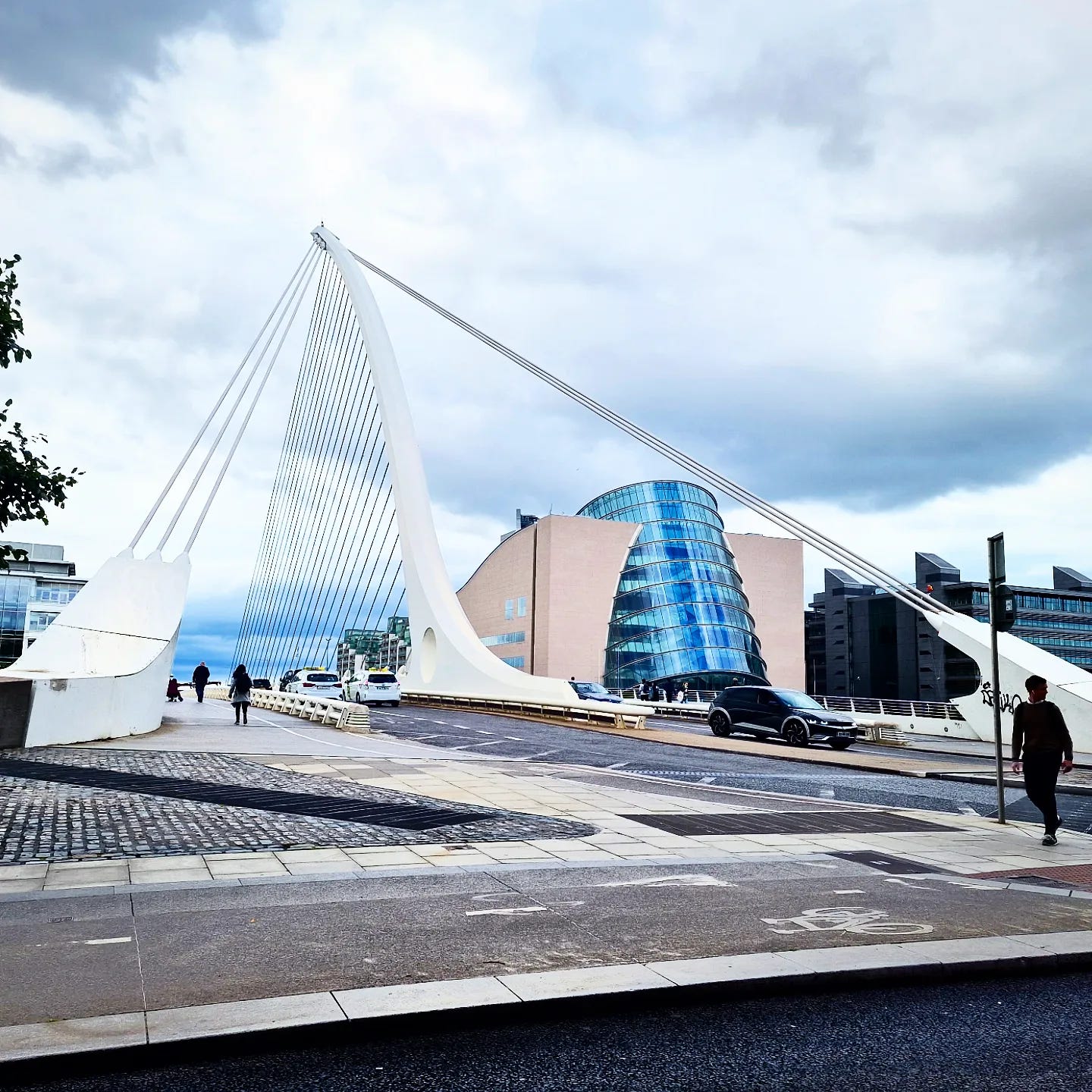
The over-running of Dublin by migrants has a grain of truth, in that some quarters feel as though they could literally be anywhere in the neo-Phoenician influence of American global hegemony. But such rumours appear greatly exaggerated by the internet. I get the feeling the Irish tiger is filling its pockets while the getting is good, and biding it’s time. You get the feeling these people have known true betrayal, tragedy, poverty, misery, death and destruction. And they are not going back to being victims, ever again. No matter what the cost.
The question many of us are asking in the West, post-covid-19, is, ‘When will we, the rest of us, cross that line’?
You know the line I mean. The line when the majority of people realise that their governments have been working against them for years? The point where the natural default position of tribal warfare returns, and our fancy glass buildings and open-plan post-modern condos have zero utility, in a world where locked doors and strong walls are once again required? Where the warrior and the gardener become one, as Bruce Lee foretold.
Some thought it would happen when the supermarkets started to run dry during the first lockdown. Others are waiting for people to realise that the recent wave of heart attacks and still-births among the healthy and young are not caused by climate change or long-convid. Yet more hold their breath waiting for markets to crash, and hyper-inflation. Or stagflation, crack-up booms, deflationary collapse, CBDC totalitarianism, or some other crystal ball black swan. Gold, bitcoins, and canned food become totemic false idols, and Mad Max looks like naive optimism.
I don’t know, but I think we’ll be living with boiling frogs for about another three or four years before the penny drops. For those complicit, it never will.
Even though the adult and rural population of Ireland gave me comfort and hope that the world is still the real world, my last couple of days of vacation tarnished my optimism slightly.
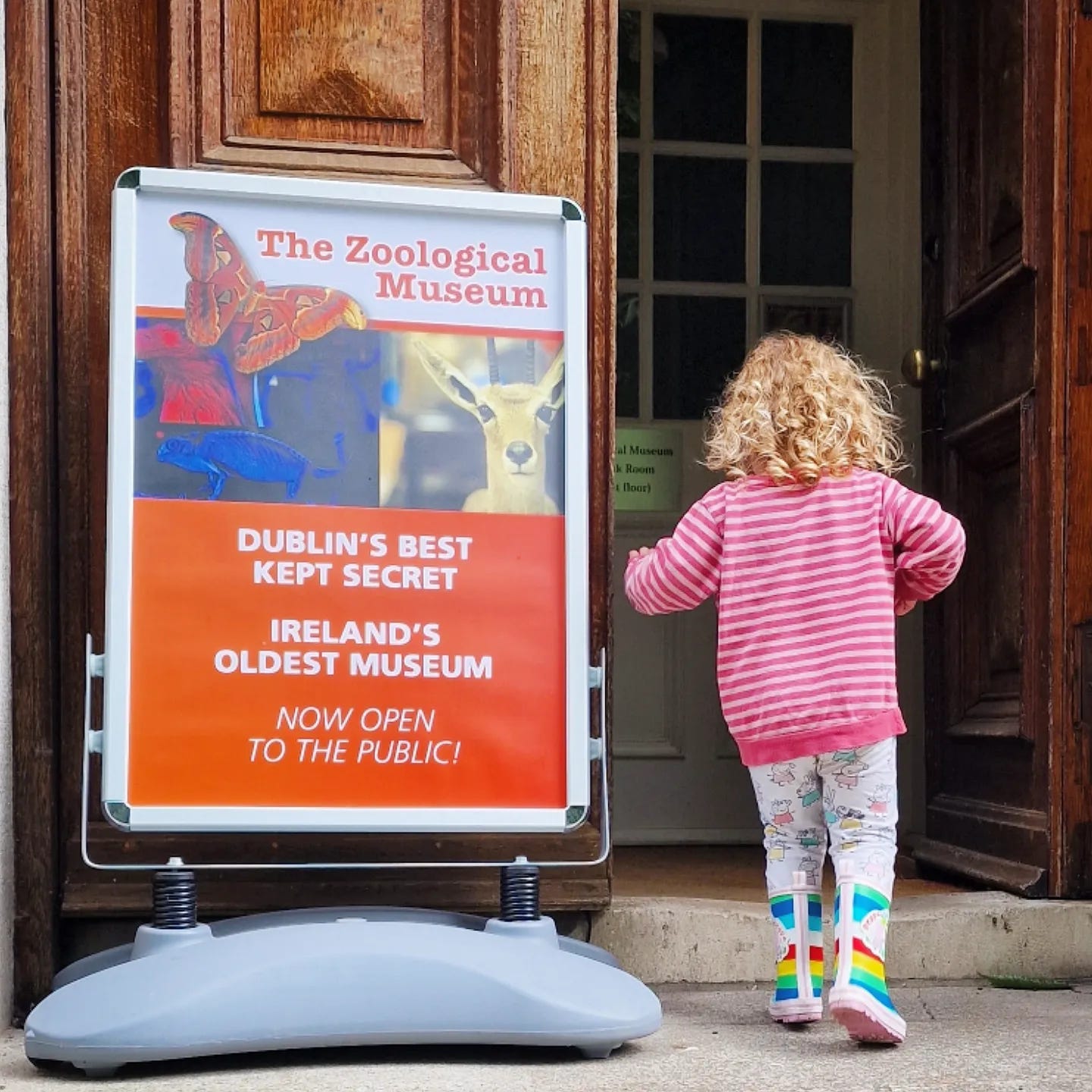
A joyful couple of days spent in Dublin involved Guinness and Stew, a tour of Trinity College – including snake handling at the Zoological Museum (Ireland’s oldest museum) – and a considerable expansion of my whisky collection. St Stephen’s Green shopping centre, the hotel swimming pool, and a tour of Butler’s chocolate factory were outstanding ways to spend time with the kids.
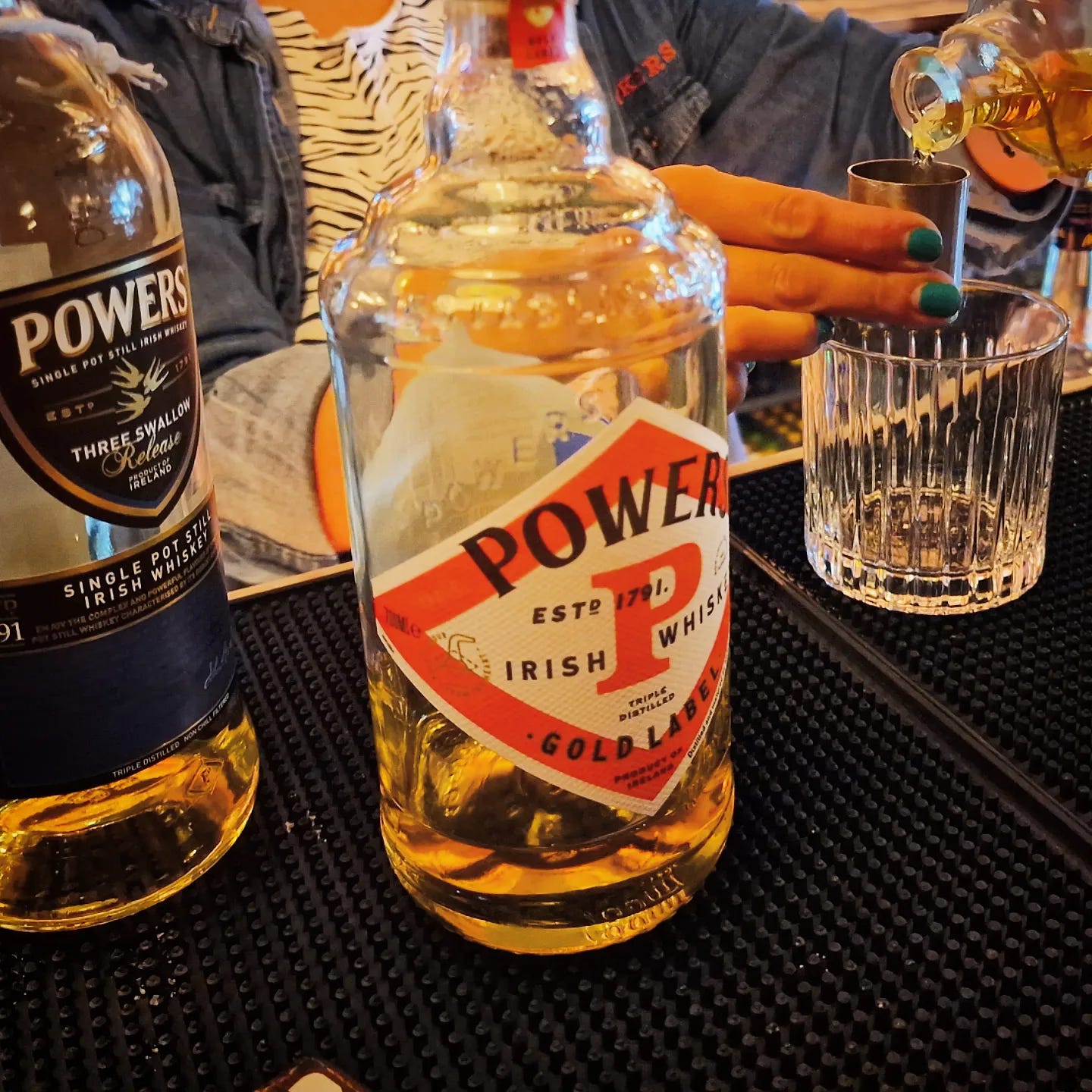
On our penultimate evening in that Viking city, my wife sent me out to fetch Sushi for us and find something for my son to eat. The boy somehow exists on a diet of cheese, apples and Macleod & Macleod’s finest Stornoway black pudding (made with suet, not vegetable oil), so food is always a challenge with him. I decided there must be a traditional Irish pub, with a traditional Irish cheese toastie machine somewhere in Dublin and set about finding it. The first couple of pubs had an excellent top shelf, which did me Powers of good, but alas, no hot cheese sandwiches to go.
Feeling suitably lubricated, and with sushi order in hand, I stopped in a local Eurospar shop to buy the boy some crisps. behind me in line, some teenagers were arguing with their friend, who was about to purchase a Covid test kit.
My uninhibited mind could not abide this going unchallenged.
Me: ‘What on earth are you buying that for’?
Local grinning idiot: ‘I have cold and flu like symptoms’.
Idiot’s friend: ‘We’d all have it anyway by now’.
Me: ‘So what if you do!? Listen to your friend. There is no requirement to test, or to isolate. So why the hell are you continuing to keep this thing going, and give these people money!?’
Local grinning idiot: ‘I don’t know. I just am.’
Me: ‘Look at the box. it literally says ‘“A Con, Made in China”. So just stop it.’

It was only crossing back north of the border, I noticed the toll booths by the toll roads outside Dublin still have government warnings up about Covid 19.
I’ve had enough of this nonsense. But then, when the WHO announced Monkey Pox as another global health emergency, and we all just ignored them, I thought everyone else had had enough as well.
I am jealous of the robustness of the Irish identity, to an extent. In the same way, I loved the people in the South of the USA. But the thing about identity is, that it is always a disappointment.
Jonathan Pageau speaks more beautifully and knowledgeably on this topic than I ever could, but he contends that we should not hope to find a home in any identity here on earth. Home in your identity does not exist. It can only ever be a feeling about the past or a hope for the future. Only when we are called home to God, will we find that spiritual home that we all crave deep down.
The tour of Butler’s chocolate factory culminated in a demonstration of how chocolate easter eggs, Santa Clause figures and easter bunnies are made. A mould is decorated, and filled with a quantity of tempered liquid chocolate. This mould is then put on a magnetic arm that spins the mould gently for two hours. We are given a smiling chocolate elephant to decorate, and are informed that this type of confection is known in the chocolate industry as a ‘Hollow Novelty’.
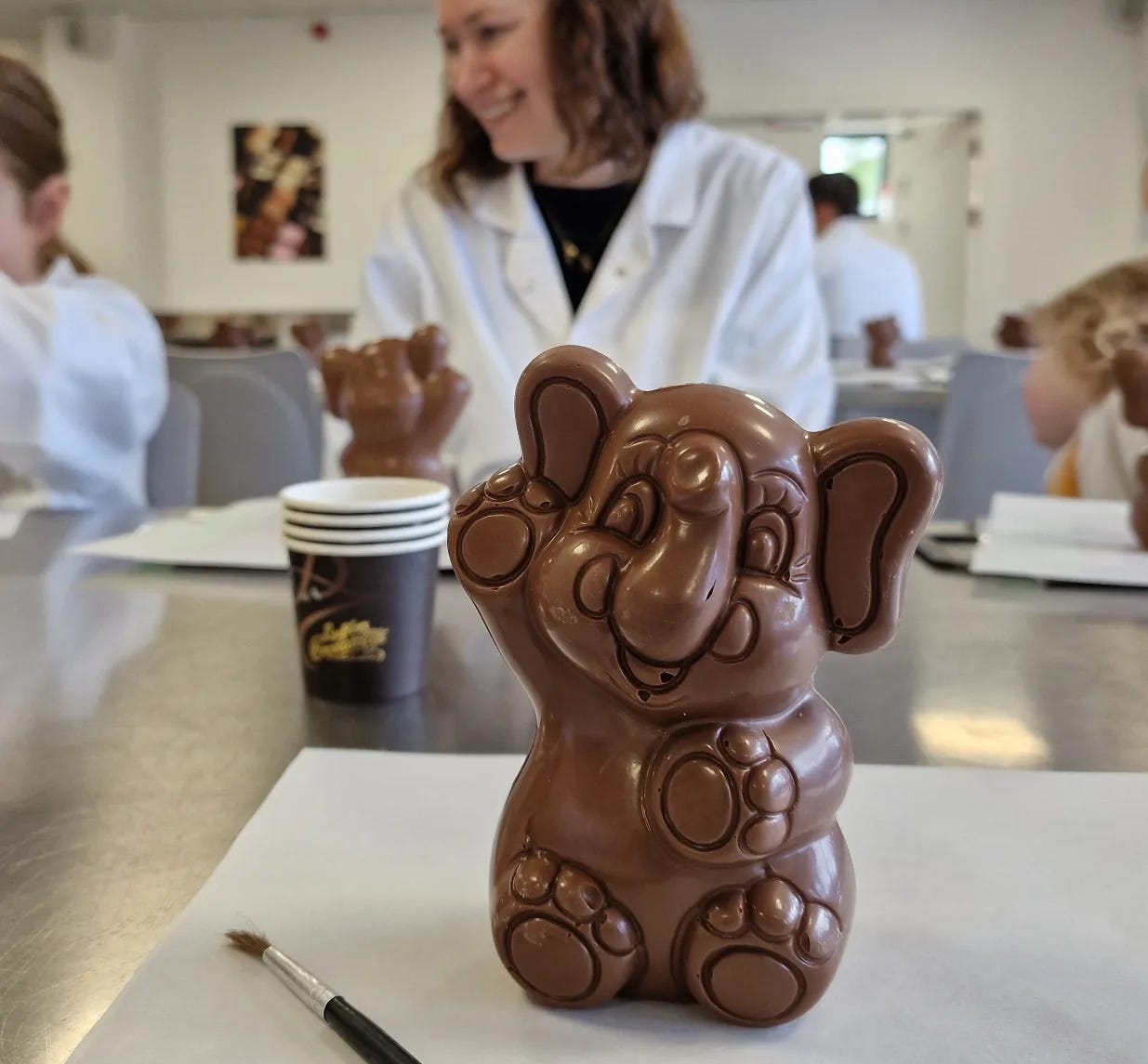
What a great phrase, I thought.
How many elements of our identities are simply that? Hollow Novelties.
Thoughts turned to my actual home. The drive back to the ferry in Belfast, the crossing, the drive back across Scotland. My living room was full of 2×4 timbers that I left there to dry out while we were gone. My bathroom and my business have holes in them. As does my living room ceiling, and floor. Everything is broken, or breaking, and begging for attention. Our friends too.
While my mind was beginning to fill up with details and to-do lists, about five or ten miles south of Newry, on the bit where the motorway isn’t the M1 anymore, I hit a cat.
I couldn’t believe it. I’ve never hit anything like that before.
A nice little black and white creature. Clean, and a likely beloved pet, was sitting by the side of the road on the left-hand verge. I was overtaking another car, so probably doing about 75 mph, when you could see this cat had decided to ‘go for it’.
I was actually astonished that he got past the first car. It was so fast that I think by the time he hit us I’d only managed to brake down to about 60 mph. The thud was horrendous, and I could feel the cat’s body bounce under my seat. My daughter noticed. ‘What was that’!? ‘Nothing’. ‘That could have been someone’s pet! I know.’
When we pulled up at the Titanic exhibition in Belfast, I couldn’t even bring myself to look at the front of the car. When I finally did, the entire lower grill was missing.
So, if you live near Newry, and you’re missing an extremely athletic, but not very safety-conscious black and white cat, I’m truly terribly sorry.
On the way back up the road, more of our life starts seeping back in, as the holiday fades.
One of my wife’s friends has started an extra-marital affair but seems to believe that because she isn’t actually married, it doesn’t matter. Although the fact that she’s hiding the sexual encounters with online dating app strangers from the father of her two children, but not my wife, creates a bit of a conundrum for us. Nice of her to include us in the lie, we thought. So generous.
I met up with my best friend from my teenage years on the ferry. He is an engineer there and was off-shift for our sailing to Cairnryan. Although we parted ways when each of us went to sea, since we were 13 years old in the Army cadets, we’ve always been able to pick up exactly where we left off. During and after the lockdowns, he and I were fully on the same page regarding the mass hypnosis that had taken place.
He is in a bad place now. He was seriously shaken by the authoritarianism of the past few years. His refusal to take the jab was accepted by his employer, Stena Line, who are Swedish and not retarded like the rest of Europe. However, the precariousness of being surrounded by true believers in the narrative was an uncomfortable place to be. Add to that, he is now passing through the broken British maritime education system for his next license up. He was hospitalised with panic attacks, and bed-ridden with total body exhaustion. His wife of one year has pieced him slowly back together, and this was his first two-week trip back at sea in a year.
I too suffered to the point of throwing up between simulator sessions, for my chief mate’s exam. The conversation turned to all the ships in his old company that had recently caught fire due to electric vehicles as cargo, and collisions and fatalities we’d known about. As we laughed about the fires on board passenger ships and the hazards that ferry passengers never have any idea about while sailing, we realised the rest of the passenger lounge may not want to hear that chat and changed the topic.
‘Well, I got my vasectomy now. That’s me fully sterilised. No kids for me!’.
He says he did it so that his wife didn’t have to take the pill anymore because he now hates the pharmaceutical industry after the obvious lies of the past few years.
‘Why don’t you do that’? says wifey.
‘I’d have more kids in a heartbeat’, says I.
‘You care so much about a stupid cat, but you don’t care that I’ve been taking hormones for twenty years’?
‘I’ve only been married to you for ten, and you were off it for half of them to get pregnant anyway, so there’.
I’m half convinced the end of the world is coming in five years anyway, so what’s the point? I’ll never do what the globalists want me to do, out of principle, is not the sort of argument my wife wants to have in the passenger lounge, so we let that one go. She knows I won’t budge on that one anyway.
However, I know my mate had a really rough childhood and has never wanted kids. I think the real reason for his depression and nihilism is way deeper. When his brother used to beat him very violently and mercilessly, his mother used to blame them both equally, and refuse to take sides or intervene. His sense of injustice was galvanised forever. His intelligence and awareness were no match for his nihilism and anguish. The atheism hasn’t helped.
He then expressed how worried he was about the coming UN-induced famine, and mass sterility caused by mRNA injections, and mRNA in the food supply.
Inflation, regulation, fear. Cancer, climate, covid.
It doesn’t matter what bullshit they’re pushing. You need to fight where you stand.
Most religions are death cults. Our secular culture has become a semi-pagan sacrificial death cult. Most of our default nature is depression, judgement, exclusion, violence, victimisation, scapegoating, conflict and justification of short-term pleasure, and sin. Most of our public discourse is about destroying norms so that our wildest desires ma run free.
Fortunately, I’m part of a life cult. The only one there is, to my knowledge.
As I’ve come home, to all of the broken little things that need my attention, I’ve realised something important.
Home is where you know all the parts that are broken. Home is where you are most disappointed because you know it well enough to know what it could be.
Your country is yours when you know its failures and its pain. Just like your family and your friends and your community are yours most fully when you come to know their deepest flaws and share in their deepest agonies.
I barely scratched the surface in Ireland. Clearly, a country with music and Whiskey as good as theirs could only be born out of great suffering. I’ll go back, and know it better one day. Knowing, that’ll I’ll always be an outsider looking in.
But here at home, in Scotland, I’ll be trying to fix our problems. And if I’m disappointed in my culture and my country, it will be up to me to cultivate a new one. There is no other way to do it.